Investment Guide
Buying Property for Investment vs Self-Use: How to Make the Right Decision
Understand the key differences between buying a property to live in and buying one as an investment before making your next real estate decision.
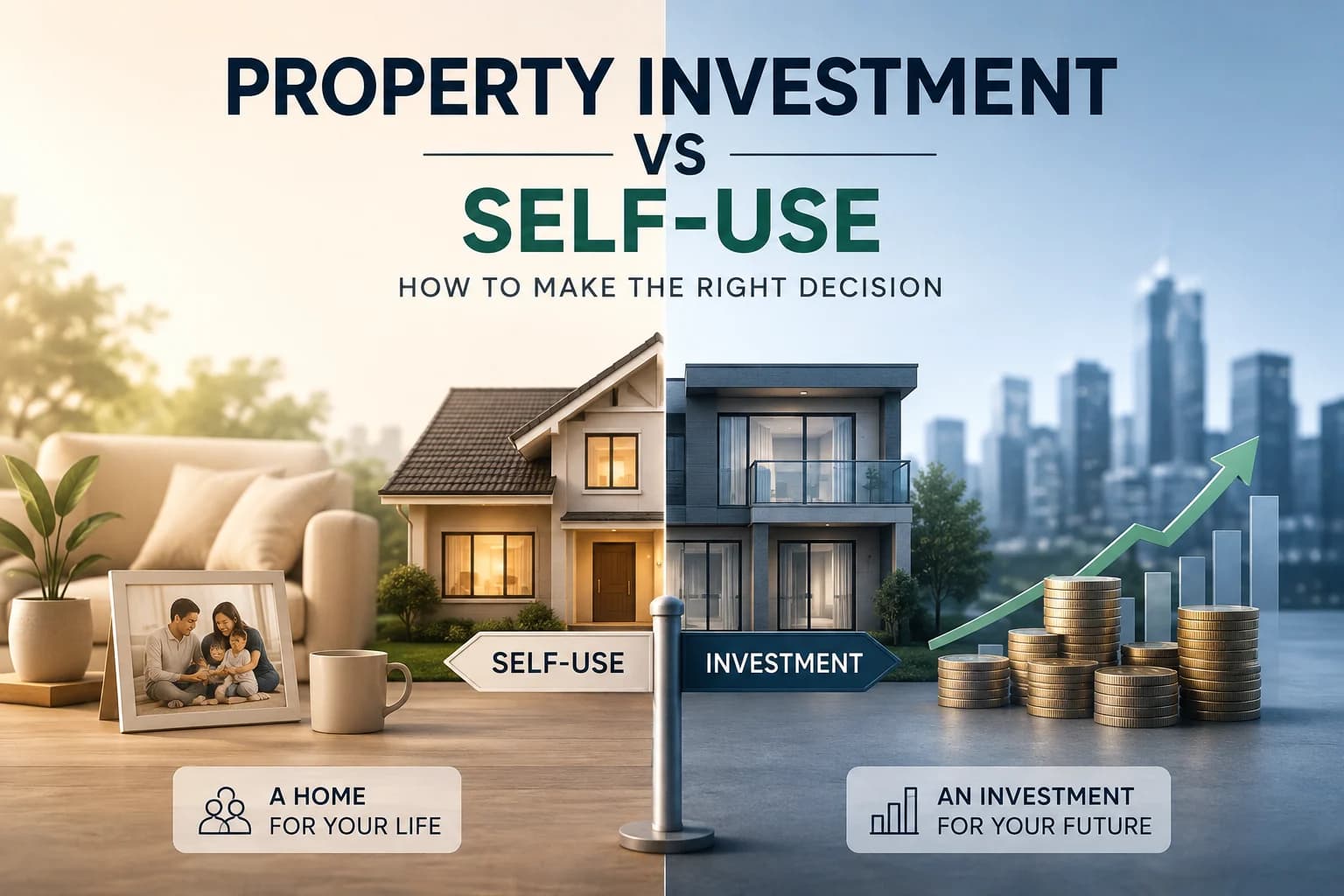
Not every property purchase should be evaluated the same way.
A property you buy to live in and a property you buy as an investment may have completely different requirements.
This distinction is important because buyers often mix emotional and financial criteria, leading to poor decisions.
Before purchasing property, be clear about one question:
Am I buying a home, or am I buying an investment?
The answer changes how you should evaluate the property.
Buying Property for Self-Use
When buying a home for yourself or your family, lifestyle matters.
You may prioritise:
- Location
- Commute
- Schools
- Hospitals
- Space
- Neighbourhood quality
- Comfort
- Security
- Amenities
Financial return is still important, but it may not be your primary objective.
For example, paying more for a property closer to your workplace may be financially justified if it saves you significant time every day.
The value is not only measured in resale price.
It is also measured in quality of life.
Buying Property as an Investment
Investment property requires a different mindset.
The main questions become:
- What is the expected rental income?
- What are the ongoing costs?
- Is there strong tenant demand?
- What is the potential for appreciation?
- How easy will it be to sell?
- What are the risks?
You should not buy an investment property simply because you personally like it.
The market does not care about your personal taste.
It cares about demand.
Rental Yield Matters
If your objective is rental income, calculate the expected yield.
A simple gross rental yield calculation is:
Annual rental income ÷ Property purchase price × 100
For example:
- Property price: ₹80 lakh
- Annual rent: ₹3.6 lakh
Gross rental yield:
₹3.6 lakh ÷ ₹80 lakh × 100 = 4.5%
However, gross yield is not your actual return.
You still need to consider:
- Maintenance
- Property taxes
- Repairs
- Vacancy periods
- Brokerage
- Loan interest
Net returns may be significantly lower.
Appreciation Is Not Guaranteed
Many buyers assume property prices will automatically increase.
That assumption is dangerous.
Property appreciation depends on:
- Location demand
- Infrastructure
- Economic activity
- Supply
- Interest rates
- Local market conditions
Some properties appreciate strongly.
Others remain stagnant for years.
Do not build your investment strategy around guaranteed appreciation.
There is no guarantee.
Compare Property to Other Investments
Property is not the only place to invest capital.
Before buying purely for investment, compare:
- Expected returns
- Liquidity
- Risk
- Management effort
- Financing costs
Real estate has advantages, including the ability to generate rental income and use leverage through loans.
But it is also relatively illiquid.
Selling a property can take months.
Stocks, mutual funds, and other investments can generally be bought and sold much faster.
Liquidity has value.
Self-Use Property Can Still Be Financially Smart
Not every good financial decision needs to maximise returns.
A self-use property can provide:
- Housing stability
- Control over your living environment
- Long-term security
- Reduced dependence on landlords
The mistake is not buying a home for yourself.
The mistake is pretending that every self-use property is automatically a high-return investment.
Keep the two concepts separate.
Questions for Self-Use Buyers
Ask:
- Can I see myself living here for several years?
- Does the location suit my lifestyle?
- Is the commute practical?
- Is there enough space for future needs?
- Can I comfortably afford the total cost?
- Does the property have reasonable resale potential?
Questions for Investors
Ask:
- Who will rent this property?
- Why would they choose this location?
- What is the realistic rental yield?
- How much supply exists?
- Who will buy this property from me later?
- How long might it take to sell?
- What happens if prices do not increase?
If you cannot answer these questions clearly, you are not investing yet.
You are speculating.
Common Mistakes
Buying an investment property based on personal taste
Your future tenant or buyer may have different priorities.
Overestimating rental income
Use realistic local market data.
Ignoring vacancy
A property earning zero rent for several months can significantly reduce returns.
Ignoring maintenance costs
Property income is not the same as property profit.
Assuming prices always increase
Real estate markets are local and cyclical.
Final Thoughts
A self-use property should improve your life.
An investment property should improve your financial position.
Sometimes a property can do both.
But do not force that assumption.
Define your objective first. Then evaluate the property using the right criteria.
The more clearly you understand why you are buying, the easier it becomes to identify whether a property is genuinely suitable or simply emotionally appealing.