Buying Guide
Hidden Costs of Buying a Property in India: What Buyers Often Forget
The property price is not the final amount you will pay. Understand stamp duty, registration, maintenance, interiors, loan charges, and other hidden costs before buying property in India.
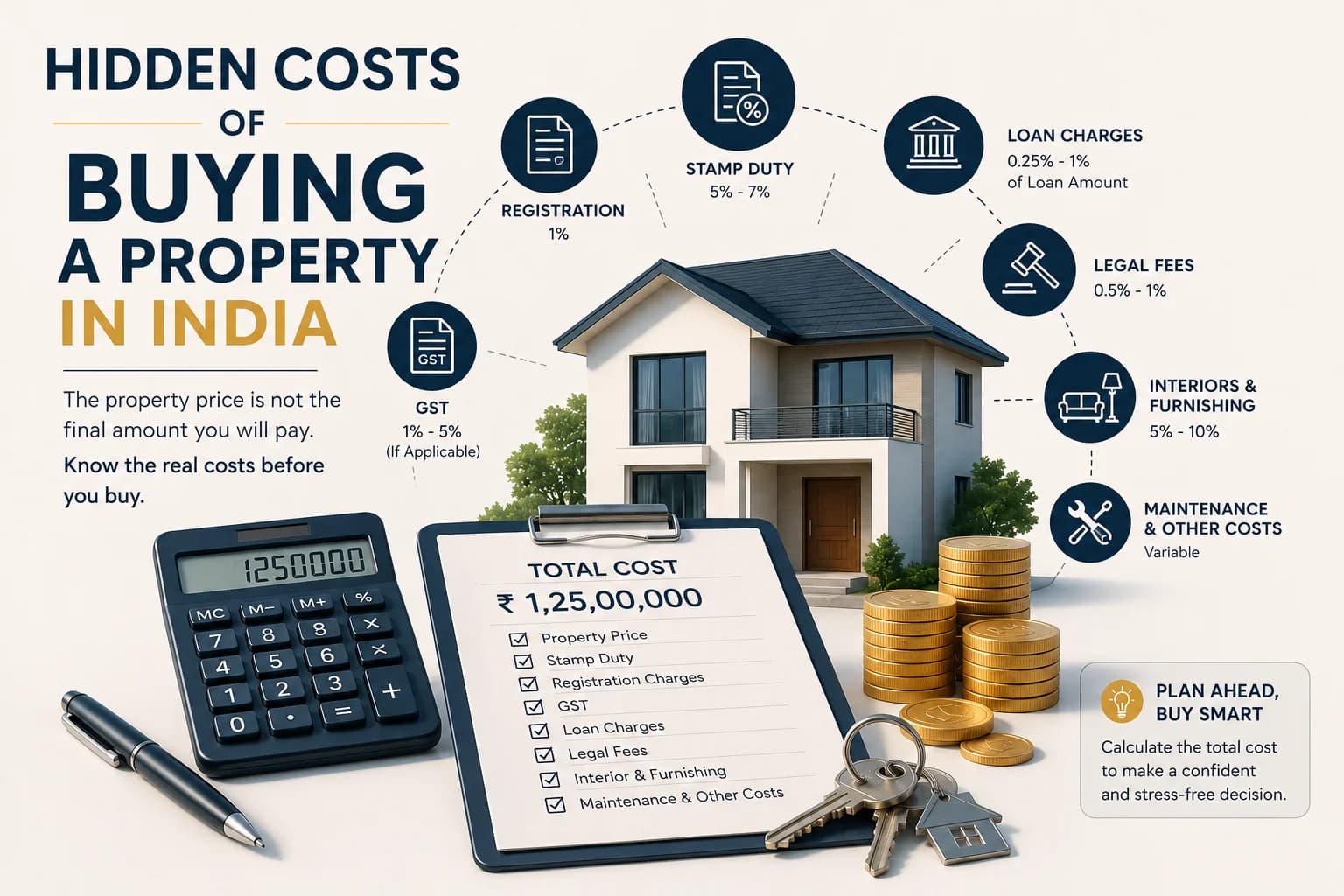
Buying a property involves much more than paying the advertised price.
Many first-time buyers focus entirely on the property's listed price and the monthly EMI. Then the actual purchase begins, and additional expenses start appearing.
Stamp duty, registration, loan charges, interiors, maintenance deposits, and furnishing costs can significantly increase the total amount you need.
The smart approach is simple:
Calculate the total cost of ownership before deciding whether you can afford a property.
1. The Property Price Is Only the Starting Point
Suppose a property is listed for ₹50 lakh.
You should not assume that ₹50 lakh is your final cost.
Depending on the property and location, you may also need to pay for:
- Stamp duty
- Registration charges
- GST, where applicable
- Legal verification
- Home loan processing
- Brokerage
- Maintenance deposits
- Parking
- Interiors
- Furniture
- Moving expenses
The final amount can be substantially higher than the advertised property price.
This is why buyers should create a complete purchase budget before paying a token amount.
2. Stamp Duty
Stamp duty is one of the largest additional costs involved in purchasing property.
The exact amount depends on factors such as:
- State
- Property type
- Property value
- Buyer category
- Applicable local regulations
Do not assume that the stamp duty rate is the same across India.
It varies by location.
Before finalising a property, calculate the applicable stamp duty based on the property's actual transaction value and the relevant rules in your state.
3. Registration Charges
Property registration is another major expense.
Registration legally records the ownership transfer.
The charges can depend on:
- State regulations
- Property value
- Transaction structure
Some buyers make the mistake of budgeting only for the down payment.
Then they discover that registration and related charges require a significant additional amount.
Keep this money separate from your property down payment.
4. GST on Applicable Properties
GST may apply to certain property purchases, particularly depending on the construction status and type of transaction.
This is an area where buyers should not make assumptions.
The tax treatment of a property can differ depending on whether it is:
- Under construction
- Ready to move
- Purchased directly from a developer
- Purchased as a resale property
Understand the applicable taxes before signing the agreement.
A lower advertised property price can become less attractive when additional taxes are included.
5. Home Loan Processing Charges
A home loan is not completely free to arrange.
Banks and financial institutions may charge for:
- Loan processing
- Legal verification
- Technical valuation
- Documentation
- Administrative services
Some charges may appear small individually.
Together, they can become meaningful.
Always ask for a complete list of loan-related charges before finalising your lender.
Do not compare lenders only by the advertised interest rate.
Compare the total borrowing cost.
6. Brokerage and Professional Fees
Depending on how you find the property, you may need to pay:
- Broker commission
- Legal fees
- Property document verification fees
- Financial advisory fees
A professional property lawyer can add to the initial cost.
But avoiding legal verification to save money can create much larger problems later.
This is one of the areas where trying to spend less can become expensive.
7. Society and Maintenance Deposits
Many properties involve additional payments to the housing society or developer.
These may include:
- Maintenance deposits
- Advance maintenance
- Clubhouse charges
- Corpus fund contributions
- Facility charges
Ask for every applicable charge in writing.
Do not rely only on verbal statements.
You need a clear breakdown of what is included in the property price and what is charged separately.
8. Parking Charges
Parking may not always be included in the advertised property price.
Depending on the project, buyers may face additional costs for:
- Covered parking
- Open parking
- Additional vehicle spaces
If parking is important to you, confirm the exact arrangement before booking the property.
Do not assume that buying an apartment automatically includes a dedicated parking space.
9. Interior and Furnishing Costs
This is one of the most underestimated parts of buying a home.
After paying for the property, buyers often still need:
- Kitchen work
- Wardrobes
- Lighting
- Fans
- Curtains
- Furniture
- Appliances
- Painting
- False ceilings
- Storage solutions
A new property can be technically ready to occupy while still requiring a significant amount of money before it feels like a functional home.
Create a separate interior budget.
Do not add these costs as an afterthought.
10. Moving Costs
Moving into a new property also involves smaller expenses that add up.
These can include:
- Packers and movers
- Cleaning
- Repairs
- Utility connections
- Internet installation
- New furniture
- Appliances
These costs may not change your decision to buy.
But they should be included in your cash planning.
11. Property Insurance
Property insurance is another cost that buyers may consider after purchase.
Depending on the property and your financial situation, insurance can help protect against certain risks.
Review the available options carefully and understand what is actually covered.
Do not buy insurance simply because it is bundled with another financial product.
12. The Opportunity Cost of Your Down Payment
This is not a direct bill.
But it is still a real financial consideration.
Money used for a down payment cannot simultaneously be used for:
- Investments
- Business expansion
- Emergency reserves
- Other financial opportunities
This does not mean you should avoid buying property.
It means you should understand the trade-off.
A property purchase should not leave you with zero financial flexibility.
Create a Complete Property Budget
Before making an offer, create a simple budget like this:
| Expense | Estimated Cost |
|---|---|
| Property price | ₹ |
| Down payment | ₹ |
| Stamp duty | ₹ |
| Registration | ₹ |
| Taxes | ₹ |
| Loan charges | ₹ |
| Legal verification | ₹ |
| Brokerage | ₹ |
| Maintenance deposit | ₹ |
| Parking | ₹ |
| Interiors | ₹ |
| Furniture and appliances | ₹ |
| Moving expenses | ₹ |
| Emergency reserve | ₹ |
The exact numbers will vary.
The purpose is to identify the complete financial commitment before you sign anything.
Questions to Ask Before Paying a Token Amount
Ask the seller, developer, or broker:
- What is included in the quoted price?
- What charges are paid separately?
- Are parking charges included?
- Are maintenance deposits required?
- Are there clubhouse or facility charges?
- What taxes apply to this transaction?
- What are the registration costs?
- Are there any outstanding dues?
- What will the estimated monthly maintenance cost be?
Get important financial details in writing.
Verbal assurances are not enough when significant money is involved.
Common Mistakes Buyers Make
Focusing Only on the EMI
The EMI is only one part of the total cost.
You still need cash for several other expenses.
Spending All Available Savings
A property purchase should not eliminate your emergency fund.
Unexpected expenses will happen.
Ignoring Interior Costs
A bare apartment can require substantial investment before it becomes comfortable to live in.
Not Asking for a Full Cost Breakdown
Always ask for the complete cost of the transaction.
If someone cannot clearly explain the charges, slow down.
Rushing Because of Sales Pressure
Statements such as:
"The price will increase tomorrow."
or
"This is the last available unit."
should not replace proper financial analysis.
A rushed purchase can create a long-term financial problem.
Final Thoughts
The cost of buying property is larger than the number shown in an advertisement.
The strongest buyers are not necessarily the ones with the largest budget.
They are the ones who understand the complete transaction before committing.
Calculate:
- Total acquisition cost
- Monthly ownership cost
- Loan burden
- Interior requirements
- Emergency reserves
- Long-term affordability
Then decide whether the property still makes financial sense.
The goal is not simply to buy a property.
The goal is to buy one without putting yourself under unnecessary financial pressure.