Buying Guide
Rent vs Buy a Property in India: Which Option Makes More Sense?
Should you continue renting or buy a home? Compare the financial, lifestyle, and long-term factors before making one of your biggest decisions.
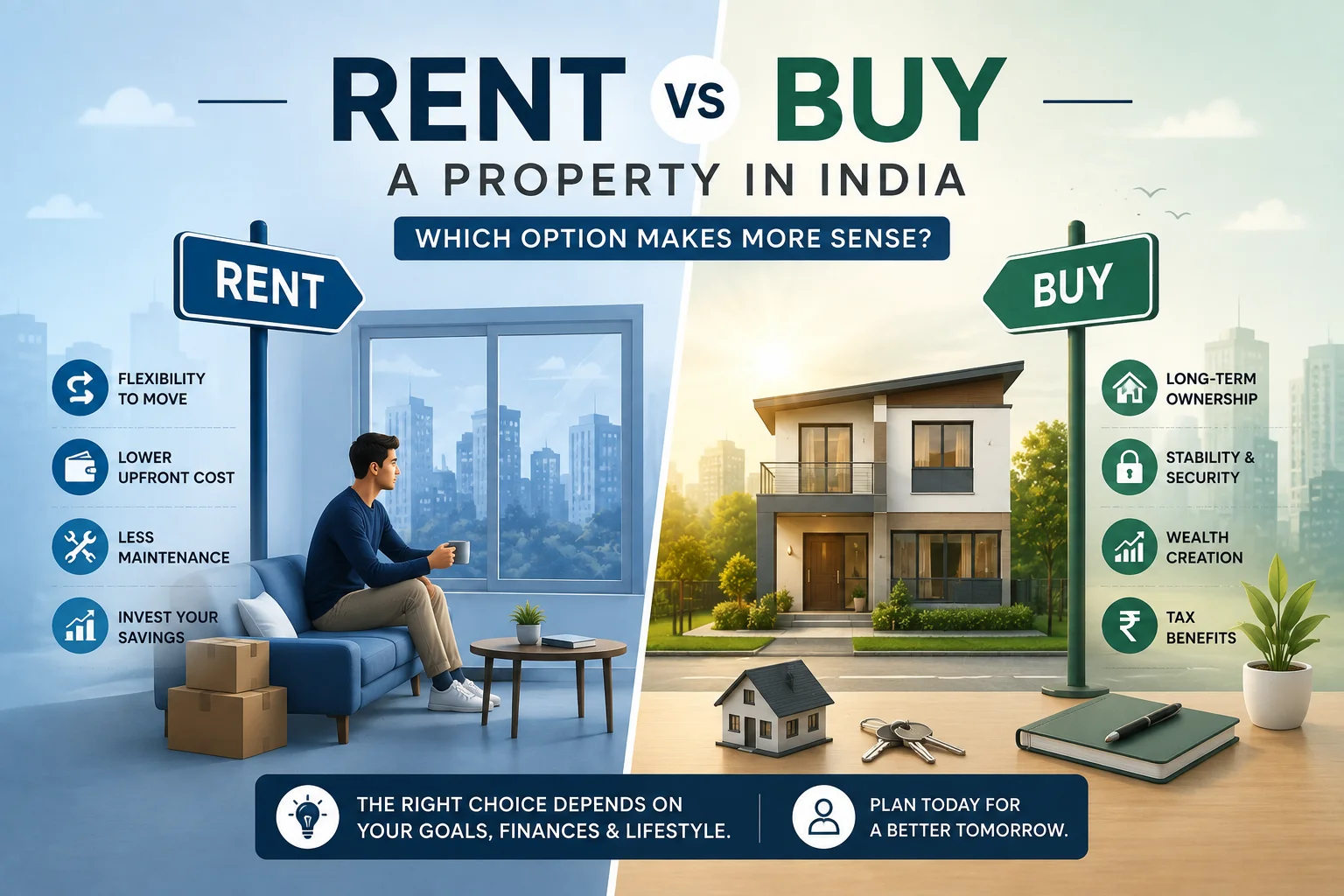
Renting versus buying a property is one of the biggest financial decisions many people make.
There is no universal answer.
Buying a home can provide stability and long-term ownership. Renting can provide flexibility and reduce the financial pressure of a large property purchase.
The right decision depends on your income, savings, career plans, location, and how long you expect to stay in the property.
The mistake is assuming that buying is always better than renting.
It is not.
1. Start With Your Time Horizon
The first question is simple:
How long do you realistically expect to stay in the same location?
If you expect to move within a few years, renting may make more sense.
Buying a property involves significant upfront and transaction costs, including:
- Down payment
- Registration charges
- Stamp duty
- Legal expenses
- Loan processing charges
- Brokerage, where applicable
- Interior and furnishing costs
Selling the property later may also involve additional costs.
Property is not highly liquid.
You cannot always sell it immediately at the price you want.
If your job, business, or lifestyle requires flexibility, renting can reduce that risk.
2. Understand the True Cost of Buying
Many people compare only:
Monthly rent vs EMI
That comparison is incomplete.
The true cost of owning a property can include:
- Home loan interest
- Property maintenance
- Repairs
- Property taxes
- Society charges
- Insurance
- Furnishing
- Opportunity cost of the down payment
For example, a large down payment means a significant amount of capital is locked into the property.
That money could otherwise be invested or used for a business.
This does not automatically mean renting is better.
It means the comparison needs to be realistic.
3. Renting Gives You Flexibility
Renting makes it easier to change:
- Cities
- Neighbourhoods
- Property size
- Lifestyle
- Commute
This can be valuable if:
- You are early in your career
- Your income is uncertain
- You may relocate
- Your family requirements may change
A renter can move.
A property owner has a large, illiquid asset attached to a specific location.
Flexibility has value.
Do not ignore it simply because it does not appear on a spreadsheet.
4. Buying Can Provide Stability
Buying a home provides a different kind of value.
You have more control over:
- Renovations
- Long-term living arrangements
- Housing stability
- Lifestyle decisions
You also avoid uncertainty around:
- Rent increases
- Landlord decisions
- Lease renewals
- Forced relocation
For families planning to stay in one location for many years, this stability can be extremely valuable.
Not every benefit needs to be measured as an investment return.
5. Compare Monthly Costs Properly
Create a realistic comparison.
| Factor | Renting | Buying |
|---|---|---|
| Monthly housing cost | Rent | EMI + maintenance |
| Upfront cost | Security deposit | Down payment + charges |
| Flexibility | High | Low |
| Maintenance responsibility | Usually limited | Higher |
| Long-term ownership | No | Yes |
| Liquidity | High | Low |
| Ability to relocate | Easy | More difficult |
The goal is not to identify which option is universally better.
The goal is to understand which option is better for your current situation.
6. Consider Your Financial Stability
Buying property with unstable finances can create unnecessary pressure.
Before buying, consider:
- Emergency savings
- Job or business stability
- Existing debt
- Future expenses
- Ability to pay EMI during difficult periods
Do not put every rupee you have into the down payment.
Property ownership should not leave you financially fragile.
If one unexpected event makes your EMI unaffordable, the purchase may have been too aggressive.
7. Think About Opportunity Cost
The down payment for a property is significant.
For example, imagine you have ₹25 lakh available.
You could:
- Use it as a property down payment
- Invest part of it
- Build a business
- Keep part as an emergency reserve
There is no single correct answer.
But the decision should be intentional.
Buying property is not simply about whether you can afford the EMI.
It is also about whether using your capital for property is the best decision for your broader financial goals.
8. Property Appreciation Is Not Guaranteed
Many people justify buying by saying:
Property prices always go up.
This is too simplistic.
Real estate performance depends on:
- Location
- Demand
- Supply
- Infrastructure
- Economic growth
- Interest rates
- Property quality
Some areas experience strong appreciation.
Others remain flat for years.
Do not buy a property solely because you expect prices to rise.
Buy based on realistic demand and a reasonable long-term strategy.
9. When Renting May Make More Sense
Renting may be the better choice if:
- You expect to move soon
- Your income is unstable
- You have not built sufficient savings
- Property prices are beyond your comfortable budget
- You need flexibility
- You can invest the difference productively
Renting is not necessarily "wasting money."
You are paying for housing and flexibility.
The same way a business pays for office space.
10. When Buying May Make More Sense
Buying may make more sense if:
- You plan to stay in the area long term
- Your finances are stable
- You have a sufficient emergency fund
- The property suits your future needs
- The EMI is comfortably manageable
- The location has consistent demand
The key word is comfortably.
Just because a bank approves a large loan does not mean you should take the maximum amount available.
Bank approval is not a financial strategy.
A Simple Decision Framework
Ask yourself these questions:
Buy if:
- You expect to stay for the long term
- You have stable finances
- You have emergency savings
- The property fits your actual needs
- The EMI does not create excessive pressure
- You understand the total ownership costs
Rent if:
- You need flexibility
- You may relocate soon
- You are still building financial stability
- Buying would consume most of your savings
- You have better uses for your capital
Common Mistakes
Comparing only rent and EMI
This ignores maintenance, taxes, interest, and opportunity cost.
Buying because of social pressure
Buying a home is a major financial decision, not a status competition.
Using all savings for the down payment
Always maintain a financial buffer.
Assuming property prices always increase
Markets and locations behave differently.
Buying more house than you need
A larger property means a larger EMI, larger maintenance costs, and more capital tied up.
Final Thoughts
Renting and buying are both valid choices.
The better option depends on your circumstances.
Buying can provide stability and long-term ownership.
Renting can provide flexibility and financial freedom.
The wrong decision is not renting or buying.
The wrong decision is committing to a property without understanding the financial consequences.
Before making a decision, define:
- Your time horizon
- Your financial capacity
- Your lifestyle needs
- Your career plans
- Your long-term goals
Then choose the option that gives you the strongest position, not the option that simply looks better to other people.